
Damascus steel knives sell on looks. That layered pattern is striking, and the price tag that comes with it signals quality. But when you’re kneeling over a beaver carcass in 28-degree weather with numb fingers, what matters is how the blade actually performs — not how it photographs.
Here’s an honest breakdown of what damascus steel does well, where it falls short, and whether it belongs in your kit.
What Damascus Steel Actually Is
Modern damascus is made by forge-welding two or more steel alloys together, then folding and drawing them out repeatedly. The result is a blade with alternating layers of high-carbon and lower-carbon steel — typically 100 to 400 layers in production knives, sometimes more.
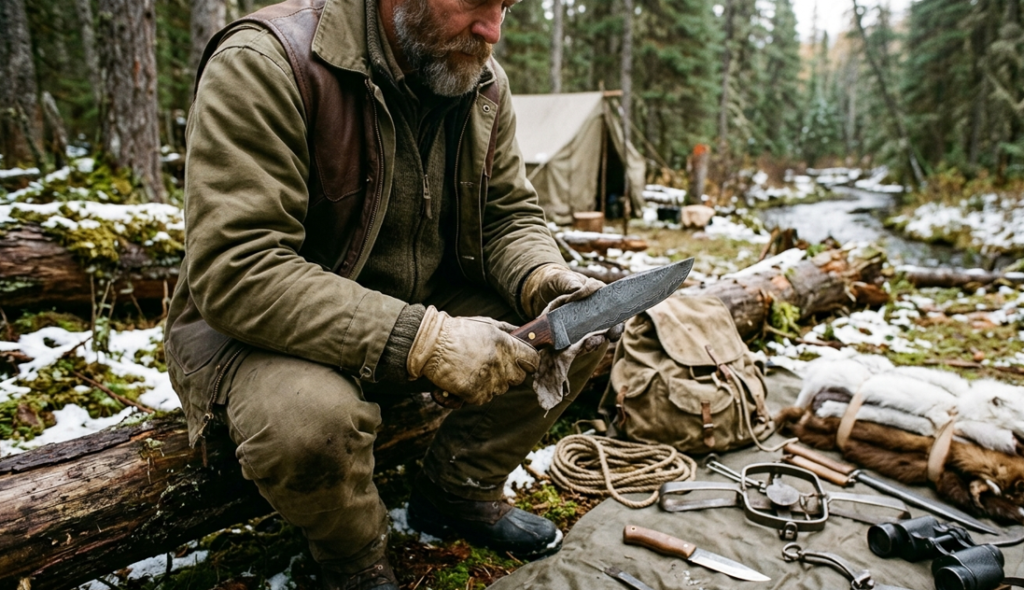
That’s it. There’s no ancient secret formula. The performance depends entirely on which steels were used and how well the smith executed the heat treatment. A damascus blade made from 1084 and 15N20 steel, properly hardened, will behave predictably. A poorly heat-treated damascus knife from a budget supplier will disappoint regardless of how many layers it has.
Does Damascus Hold an Edge Better Than Monosteel?
Not inherently. Edge retention depends on the steel’s hardness (measured in HRC) and the geometry of the grind — not on whether the blade is patterned or plain.
A well-made damascus knife from quality high-carbon alloys can reach HRC 60–62, which is competitive with monosteel options like CPM-154 or D2. But a monosteel blade at the same hardness, from a reputable maker, will perform comparably — and often more consistently, because there are no variables introduced by the welding process.
The myth that damascus holds a “micro-serrated” edge from the alternating layers is largely overstated. At the scale of actual cutting, those layer transitions don’t function as teeth. What you get is a blade that performs according to its steel composition and heat treat — same as any other knife.
How Does It Perform on Fur-Bearing Animals and Game?
This is where field conditions matter more than metallurgy charts.
When skinning muskrat, mink, or beaver, you’re working with thin cuts, precise control, and frequent contact with fat and membrane. A sharp knife of almost any quality steel will do this job. The question is how long it stays sharp and how easy it is to touch up in the field.
High-carbon damascus cuts well initially. The problem shows up after extended use on larger animals — coyote, deer, or beaver with thick castor glands — where you’re working through connective tissue and occasionally grazing bone. Here, edge stability matters. Monosteel blades in tool steels like D2 or S30V tend to hold up more consistently under lateral stress because the steel’s properties are uniform throughout.
Think of it like a laminated wood bow versus a single-piece longbow. The laminated version can be engineered for specific flex characteristics, but if the glue lines aren’t perfect, you introduce weak points. Damascus done right is excellent. Done wrong, it’s unpredictable.
The Real Problem: Corrosion in Field Conditions
This is where damascus loses ground fast.
Most damascus is made from high-carbon steels. High-carbon steel rusts. When you’re processing fur-bearers in wet conditions — working a trapline in November rain, skinning animals with blood and fat on your hands — a carbon steel blade needs attention after every use.
Blood accelerates oxidation significantly. Fat traps moisture against the blade. If you sheath a damp damascus knife and leave it overnight, you can wake up to surface rust by morning. That’s not a defect — it’s the nature of the material.
“I’ve seen guys ruin a $300 damascus knife in a single season because they treated it like stainless. Wipe it dry, hit it with a light coat of food-safe mineral oil after every session. That’s non-negotiable with high-carbon damascus in the field.”
Stainless monosteel options — CPM-S35VN, for example — require far less maintenance in wet conditions. That’s a real operational advantage on a long trapline where you’re processing 20 animals before breakfast.
Field Maintenance: What You’re Actually Signing Up For
Owning a damascus knife in the field means committing to a maintenance routine. Here’s what that looks like in practice:
- Wipe the blade clean after each animal
- Dry it thoroughly before sheathing
- Apply a thin coat of mineral oil or blade wax at the end of each day
- Inspect for rust spots weekly during active season
- Touch up the edge with a ceramic rod or strop — avoid aggressive reprofiling unless necessary
That’s not excessive, but it’s more than a stainless blade demands. If you’re running a 40-trap line and processing animals in the dark at 5 a.m., that extra step matters.
Damascus vs. Monosteel: Direct Comparison
| Characteristic | Damascus (High-Carbon) | Monosteel (e.g., D2, S35VN) |
| Edge retention | Good to excellent (steel-dependent) | Good to excellent (consistent) |
| Corrosion resistance | Low — requires active maintenance | Moderate to high |
| Ease of field sharpening | Moderate | Moderate to easy |
| Toughness under lateral stress | Variable (weld quality matters) | Consistent |
| Cost | Higher ($150–$500+ for quality) | Lower to moderate ($80–$300) |
| Repairability in the field | Harder to touch up evenly | Straightforward |
| Aesthetic value | High | Low to moderate |
When Is Damascus Actually Worth It?
A trapper in Montana ran a mixed kit for two seasons — a damascus skinner from a reputable American bladesmith alongside a D2 monosteel drop-point. His assessment after processing over 300 animals: the damascus performed slightly better on fine skinning work around the face and legs of mink, where the thin, acute edge geometry held up well. On beaver and coyote, the D2 was more forgiving and easier to maintain.
That tracks with the metallurgy. Damascus shines when the maker has optimized the steel combination for a specific task and the heat treat is dialed in. For precision skinning work where you’re taking your time, it’s a legitimate tool. For high-volume processing in wet conditions, monosteel is more practical.
“For population control work where I’m processing multiple animals quickly in variable weather, I reach for stainless monosteel every time. My damascus knife stays in the kit for specific tasks — it’s not my go-to field blade.”
The Bottom Line on Damascus for Trappers and Hunters
- Damascus steel is not inherently superior to monosteel — performance depends on the specific alloys used and the quality of heat treatment.
- The corrosion vulnerability of high-carbon damascus is a real operational cost in wet field conditions, not a minor inconvenience.
- For precision skinning tasks where you control the conditions, a quality damascus blade from a reputable maker is a legitimate choice.
Choosing damascus for its performance means accepting higher maintenance demands in exchange for a blade that, when made well, handles fine cutting work with excellent feel. That’s a reasonable trade for some applications. For high-volume trapline work in harsh weather, a quality monosteel knife will serve you better with less effort.
Buy damascus because you want it and you’ll maintain it properly. Not because someone told you it’s sharper.
For further reading on blade steel metallurgy and field performance, see the American Bladesmith Society’s technical resources at americanbladesmith.com and the steel comparison data maintained at knifesteelnerds.com.