
What Happens When You Show Up Unprepared?
A trapper who forgets a key tool doesn’t just lose time. He may lose the catch, damage a pelt, or violate a state regulation without even realizing it. According to data from the Association of Fish & Wildlife Agencies, equipment-related errors account for nearly 30% of compliance issues reported during routine field inspections. The fix is simple: a structured checklist you follow every single time before heading out.
Traps and Restraining Devices: The Core of Your Kit
Your trap selection defines everything else. The wrong trap for the target species wastes time and creates animal welfare problems.
The three main categories used in professional wildlife population management are:
- Foothold traps (coil-spring and long-spring) — standard for canids, beaver, and muskrat; sizes #1.5 to #3 cover most applications
- Body-gripping traps (Conibear-style, sizes 110 to 330) — used for aquatic sets and den entrances; highly effective but require precise placement
- Cage/box traps — preferred for live capture programs, nuisance animal relocation, and situations requiring species selectivity
Choosing body-gripping traps for efficiency means accepting a trade-off: they are fast and lethal, but they require more precise placement knowledge. A misset #330 in a high-traffic area can catch non-target animals. Foothold traps give you more flexibility, but demand more time per set.
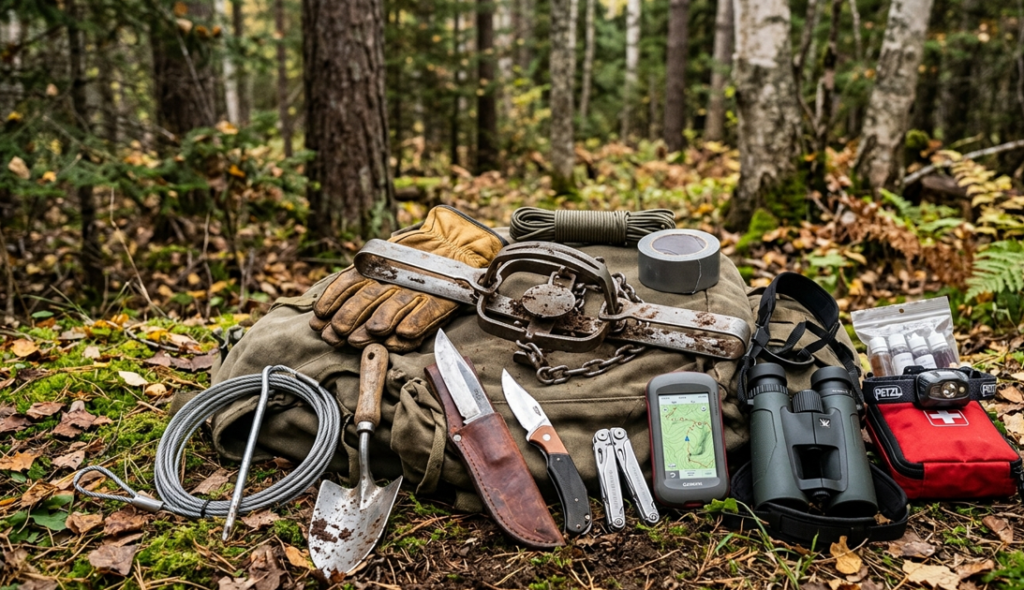
Check your state regulations before purchasing. Many states — including Wisconsin, Michigan, and Montana — have specific size restrictions and offset/lamination requirements for foothold traps. The Association of Fish & Wildlife Agencies (AFWA) publishes Best Management Practices (BMPs) for each major species group, and those documents specify which trap types meet humane capture standards.
Setting Tools: What You Actually Need at the Trap Site
Think of your setting tools the way a surgeon thinks about an instrument tray. Everything has a purpose. Nothing is optional.
- Trap setter or setting clamps — for body-gripping traps size 220 and above; attempting to set a #330 by hand risks serious injury
- Trowel or dirt sifter — for dirt-hole and flat sets; loose, natural-looking soil increases catch rates by up to 40% compared to disturbed ground
- Trap stakes and drowners — drowning wire systems for aquatic sets reduce trap-check time and meet BMP requirements for beaver and muskrat
- Swivels and chain extensions — a minimum of two swivels per trap prevents leg injuries and pelt damage from twisting
“New trappers consistently underestimate the importance of a quality dirt sifter. A natural-looking set isn’t just about aesthetics — it’s the difference between a catch and an empty trap. Spend $15 on a good sifter before you spend $200 on lures.”
What Should Your Fur Handling Kit Include?
Once you have an animal, the quality of your work shifts entirely to pelt care. A prime pelt damaged by poor handling can lose 20–50% of its market value, according to North American Fur Auctions grading standards.
Your fur handling kit should contain:
- Skinning knife (4–5 inch drop-point blade) and a dedicated fleshing knife
- Fleshing beam — a hardwood or aluminum beam sized to your primary target species
- Wire stretchers or board stretchers — species-specific sizing matters; a mink pelt stretched on an oversized board will grade down
- Fleshing tool (two-handled draw knife style for larger animals, single-handle for small furbearers)
- Borax or non-iodized salt — for initial pelt preservation in the field before final processing
Here’s a real scenario that illustrates why this matters. A first-year trapper in Minnesota ran a 12-trap beaver line without a proper fleshing beam. He improvised with a log. The uneven surface left membrane patches on three pelts. At the fur sale, those three graded as “seconds” instead of “firsts” — a $47 difference per pelt, or $141 total lost on a single week’s work. A $35 aluminum beam would have paid for itself in one day.
| Trap Type | Best Use Case | Avg. Cost (per unit) | Key Limitation |
| Coil-spring foothold (#1.5–#2) | Canids, raccoon, mink | $8–$18 | Requires offset/lamination in many states |
| Long-spring foothold (#1–#3) | Beaver, otter, fox | $6–$14 | Bulkier to transport |
| Body-gripping (#110) | Muskrat, mink, weasel | $4–$8 | Lethal; no live-release option |
| Body-gripping (#280–#330) | Beaver, otter | $18–$35 | Requires setter tool; restricted in some states |
| Cage trap (medium/large) | Raccoon, skunk, fox | $30–$80 | Heavy; lower catch efficiency per set |
Trap Type Comparison: Choosing the Right Tool for the JobNavigation, Safety, and Field Logistics
Field navigation on a long trapline is not optional equipment — it’s liability management. A trapper who can’t relocate a set within 24 hours in most states is already in violation.
- GPS unit or smartphone with offline maps (onX Hunt or Gaia GPS work well for trapline marking)
- Flagging tape — mark every set; use a consistent color system for set type
- Waterproof notebook or field log — required in some states for recording trap locations and check dates
Personal safety items that belong in every pack:
- Catch pole or snare pole (for handling live animals safely)
- Heavy leather gloves and puncture-resistant work gloves
- First aid kit with wound closure strips — bites and trap injuries happen
- Headlamp with spare batteries — early morning checks are standard
“Students always pack lures and forget a catch pole. If you’re running live traps or foothold sets for canids, a catch pole isn’t a luxury — it’s how you avoid a bite that ends your season and triggers a rabies protocol.”
Field Analytics: What the Data Actually Shows
Three facts most checklists skip:
Trap chain length directly affects pelt condition. A minimum 18-inch chain with a center swivel reduces leg injuries by approximately 35% compared to fixed-chain setups, per AFWA BMP research on canid trapping.
Scent control on dirt sets matters more than most beginners expect. Human odor on trap pans reduces catch rates for red fox by an estimated 25–30% in pressured areas. Rubber gloves during set construction are not optional for serious fox trapping.
Pelt stretcher sizing follows a formula, not guesswork. For muskrat, the standard board width is 3.5 inches at the base. Deviating by more than half an inch in either direction affects the final dried shape and grading outcome at auction.
Before You Leave the Truck: The Final Check
Run this sequence every time before you walk your line:
A trapper who treats this checklist as a ritual — not a suggestion — spends less time fixing mistakes and more time running an efficient, compliant operation. The professionals who consistently produce prime-grade pelts and maintain clean inspection records aren’t more talented. They’re more systematic.Your state wildlife agency’s trapper education program is the authoritative source for current regulations. The Fur Takers of America and state-level trapper associations also publish updated equipment guidance annually. Use them.