
Blade Shape: Where Every Cut Begins
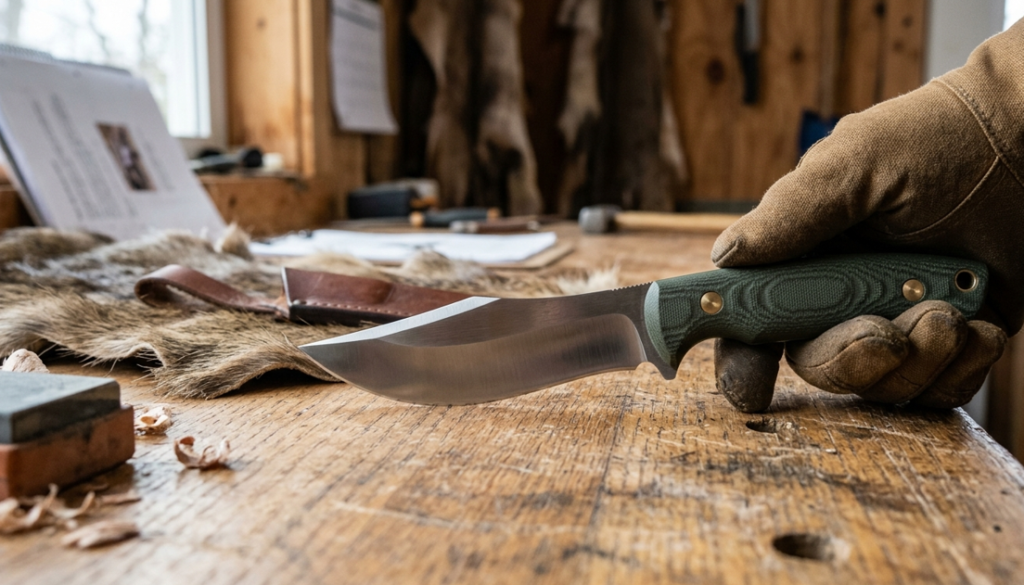
The blade profile determines how the knife moves through tissue and membrane. For skinning work, three shapes dominate professional use: drop point, trailing point, and semi-skinner (also called the American skinner).
The drop point keeps the spine running nearly straight to a controlled tip. This limits accidental punctures when separating hide from the carcass — critical when working mink, marten, or beaver where a single slip costs you a clean pelt. The trailing point curves upward, giving you a longer belly for long, sweeping strokes on larger animals like coyotes or deer. The semi-skinner sits between the two: a pronounced belly with a slightly upswept tip, optimized for circular cuts around legs and face.
Choosing the wrong profile for the species is one of the most common sources of hide damage. It’s not about preference — it’s about geometry matching the task.
Grind Profile: The Engine Under the Hood
The grind is the cross-sectional shape of the blade from spine to edge. It determines how the knife enters tissue, how it releases, and how long the edge holds up under field conditions.
- Full flat grind — the blade tapers evenly from spine to edge. Thin behind the edge, excellent slicing performance, minimal drag. The trade-off: thinner geometry means the edge is more vulnerable to rolling on frozen hide or bone contact. Best for warm-weather work on medium-sized furbearers.
- Hollow grind — concave sides create an extremely thin, razor-sharp edge. Outstanding for fine detail work around ears, eyes, and face. The cost: reduced durability. A hollow-ground edge on a frozen coyote in January will show wear after a single animal.
- Convex grind — the blade curves outward, creating a robust, self-steering edge that pushes through tissue rather than slicing. Slower cutting, but the edge holds up under abuse. Preferred by trappers processing large volumes in cold conditions where resharpening time is limited.
Think of grind geometry like the tire profile on a truck: a low-profile performance tire gives you precision on dry pavement, but you wouldn’t run it through a muddy field in November. Match the grind to your operating conditions.
What Bevel Angle Actually Does to Your Edge
The bevel angle — measured per side — directly controls the balance between sharpness and durability.
- 15–17° per side: Maximum sharpness, minimum edge retention. Appropriate for fine fur work on small animals (muskrat, ermine) where precision matters more than longevity.
- 18–22° per side: The professional standard for most skinning applications. Balances sharpness with field durability across a full day of processing.
- 23–25° per side: Reduced sharpness, significantly improved edge stability. Use this range when working frozen carcasses or when you need to go several animals between touch-ups.
A 2° change in bevel angle may sound trivial. In practice, moving from 20° to 22° per side can extend edge life by 30–40% on frozen hide — a meaningful difference when you’re running a 50-trap line.
“Most professionals sharpen too aggressively for their actual conditions. If you’re working frozen animals in January, don’t chase a 15-degree edge — you’ll be touching up every third animal. Set your bevel at 21–22 degrees and use a ceramic rod between animals. You’ll process more pelts per hour, not fewer.”
Spine Thickness: The Variable Nobody Talks About
Spine thickness controls rigidity and the knife’s ability to follow contours without flexing unpredictably. For skinning, this matters most when separating the hide from the back and shoulders — areas where the membrane is tight and the margin for error is small.
A spine of 3–4 mm gives you enough rigidity for controlled cuts without the knife wandering. Thinner spines (under 2.5 mm) flex under lateral pressure, which increases the risk of cutting through the hide on tight spots. Thicker spines (over 5 mm) add unnecessary weight and reduce the knife’s sensitivity — you lose tactile feedback through the handle.
A field scenario worth knowing: A trapper processing 20+ beaver per day switched from a 4.5 mm spine knife to a 3.2 mm spine with a full flat grind. Processing time per animal dropped from 11 minutes to 8 minutes, with a measurable reduction in membrane cuts on the belly hide — the most commercially sensitive area on a beaver pelt.
Steel Selection: Performance vs. Field Reality
| Steel Type | Edge Retention | Corrosion Resistance | Ease of Field Sharpening | Best Application |
| 1095 High Carbon | High | Low | Very Easy | Dry conditions, high-volume processing |
| D2 Semi-Stainless | Very High | Moderate | Moderate | Cold/wet conditions, large predators |
| S30V Stainless | Very High | High | Difficult | Multi-day field use, no sharpening access |
| 440C Stainless | Moderate | Very High | Easy | Wet/aquatic species (beaver, otter, muskrat) |
| CPM-154 | High | High | Moderate | General professional use, balanced performance |
High-carbon steels like 1095 sharpen fast on a leather strop — a real advantage at -20°F when your hands are cold and you need a quick touch-up. The trade-off: without proper drying and oiling after each session, surface rust appears within 48 hours. Stainless options like S30V hold an edge through 15–20 animals without touching up, but when the edge finally goes, you need a diamond stone to bring it back. In the field, that’s a problem.
“For aquatic species, corrosion resistance isn’t optional — it’s a maintenance cost. A 440C or CPM-154 blade that you can rinse, dry, and put away without worrying about rust will outlast a high-carbon blade in that environment by two to three seasons, even if the high-carbon steel technically holds a finer edge.”
Tip Geometry: Precision Where It Counts
The tip is where most hide damage happens. A sharp, fine tip gives you control around the face, ears, and legs — but it also catches on membrane and punctures hide if your angle drifts even slightly.
A rounded or blunted tip (sometimes called a “gut hook alternative”) reduces puncture risk on the belly and inner leg. You sacrifice some precision on detail work, but on high-volume processing of medium furbearers, the reduction in damaged pelts more than compensates.
Matching Geometry to Species: A Practical Reference
- Small furbearers (mink, marten, ermine): Trailing point or drop point, hollow or flat grind, 15–17° bevel, thin spine (2.5–3 mm), high-carbon or CPM-154 steel
- Medium furbearers (fox, raccoon, beaver): Drop point or semi-skinner, flat grind, 18–21° bevel, 3–3.5 mm spine, 440C or CPM-154
- Large predators and ungulates (coyote, bobcat, deer): Drop point or semi-skinner, convex or flat grind, 20–22° bevel, 3.5–4 mm spine, D2 or S30V
Field Maintenance: Keeping Geometry Intact
Edge geometry degrades faster than most professionals account for. A 20° bevel maintained on a coarse stone without a guide will drift to 25° within three or four sharpenings — and you won’t feel it until your cut quality drops noticeably.
The practical fix:
Use an angle-guided system (Lansky, Edge Pro, or equivalent) for bench sharpening at the start and end of season. In the field, use a ceramic rod at the established angle for touch-ups only — never a coarse stone unless the edge is visibly damaged. This keeps your geometry consistent across the season.
Blade geometry isn’t a one-time decision. It’s something you maintain actively, the same way you maintain your traps. The knife that processes clean pelts in October will process damaged ones in February if you’ve let the geometry drift.
For regulatory standards on furbearer harvest and pelt handling in your state, refer to your state wildlife agency guidelines. AFWA (Association of Fish & Wildlife Agencies) publishes interstate furbearer management standards at fishwildlife.org. Steel metallurgy data referenced from the American Knife & Tool Institute technical resources at akti.org.